
Few periods in history can act as explainers to the formation of our modern world, inextricably linked to the founding of nations, social movements, cultures, and ways of life. In 1492, Christopher Columbus kicked off an age of exploration that did just that. On behalf of Spain, he was in search of a direct trade route to East Asia that could circumvent the stranglehold the Ottomans had on European markets. He eventually crash landed on the island of The Bahamas. Until his death in 1506, Columbus believed he had reached the islands of the East Indies off the coast of Asia. It wasn’t until another Italian explorer, Amerigo Vespucci, made a number of expeditions to these new lands from 1502-1504, and challenged the conventional wisdom. He theorized that Columbus had actually discovered a new continent never before seen on a world map. Convinced of these findings, mapmakers of the time expanded humanity’s understanding of the world around them, naming this land “America”, in recognition of Amerigo’s intellectual pioneering.
Columbus’ initial pursuits and Amerigo’s breakthrough theory set off a frenzy in Spain and eventually the rest of Europe. Hearing tales of adventure and discovery, scores of Spanish “conquistadors” sought to achieve personal glory in far off lands, emulating the likes of Julius Caesar and Alexander the Great. The Spanish Crown saw these new lands as a treasure chest of unlimited wealth, a blank canvas to expand its territory, and a pilgrimage in service to God. With the Crown’s unbounded support, this age of exploration brought Spanish conquistador, Hernan Cortes, to the doorstep of the Aztec Empire.
The Aztecs at that time had built one of the most advanced civilizations in the New World. Spanning central Mexico from the Pacific to the Gulf of Mexico, the Empire commanded up to ten million people through advanced systems of irrigation, agriculture, education, and political administration. As a warrior society, the Aztecs expanded their reach through brutal military campaigns using the threat of violence to control subordinate territories. When their supreme leader, Montezuma, heard reports of strange bearded men making their way from the coast, he consulted with his priests and nobles, ultimately deciding to meet with the Spanish and learn more about what they had to offer. On November 8, 1519, Montezuma welcomed Cortes, the leader of those strange bearded men, into the Aztec capital of Tenochtitlan in a meeting that would bring about the ultimate clash of civilizations and a permanent reorganization of global human society.
In less than two years, Cortes and his band of conquistadors defeated this mighty empire and set about the colonization of the entire Western Hemisphere by European superpowers. For years, scholars have debated how these events came to be. How did Cortes, an otherwise obscure Spaniard, go into a foreign land and conquer an empire of millions with just an army of hundreds? La Malinche, a Mesoamerican slave given to Cortes early in the expedition, could offer an explanation. Through the course of the Spanish-Aztec War, she was by his side every step of the way to act as a translator, strategist, and negotiator. She was the conquistador’s eyes, ears, and voice as she helped navigate the Mexican mainland, secure alliances with local tribes, broker deals with Montezuma and other Aztec nobles, and relay crucial intelligence reports to Cortes. For the Spanish facing hostile armies in a foreign land, having a trusted native ally so intimately connected to their every move and decision was instrumental to their success.
La Malinche was an indispensable advisor to Cortes from his first contacts with Mesoamerican tribes to the pivotal meeting with Montezuma…
La Malinche had a complicated childhood – going from royalty to slavery. She was the daughter of two local rulers of the Aztec Empire in the Yucatan Peninsula, an area of modern day Mexico that mixed Aztec and Mayan territories. La Malinche likely experienced an early life of comfort, luxury, and personal enrichment, including early education. When she was about eight or nine years old, her father died, her mother married and bore a son to another local ruler, then sold La Malinche to a nearby tribe in order to solidify the inheritance of her new son. She would spend the next ten years of her life in servitude, eventually being traded to the Mayans in the city of Potonchan.
She came under Cortes’ control when the conquistadors encountered the Potonchan tribe early in their expedition. As a welcoming gift, the Potonchan exchanged twenty women slaves to Cortes and his men, one of them being La Malinche. At the time, Cortes’ only interpreter was Geronimo de Aguilar, a Spaniard he freed from captivity and who had been held by the Maya since 1511 from an earlier expedition along the coast. Unfortunately for Cortes, Aguilar could only translate Mayan, which would prove useless as the conquistadors made their way deeper into Aztec territory in search of gold. La Malinche was the key to Nahuatl, the language of the Aztecs. With her addition, Cortes could communicate with Nahua tribes via La Malinche, who would translate in Mayan to Aguilar, who would then translate to Spanish.
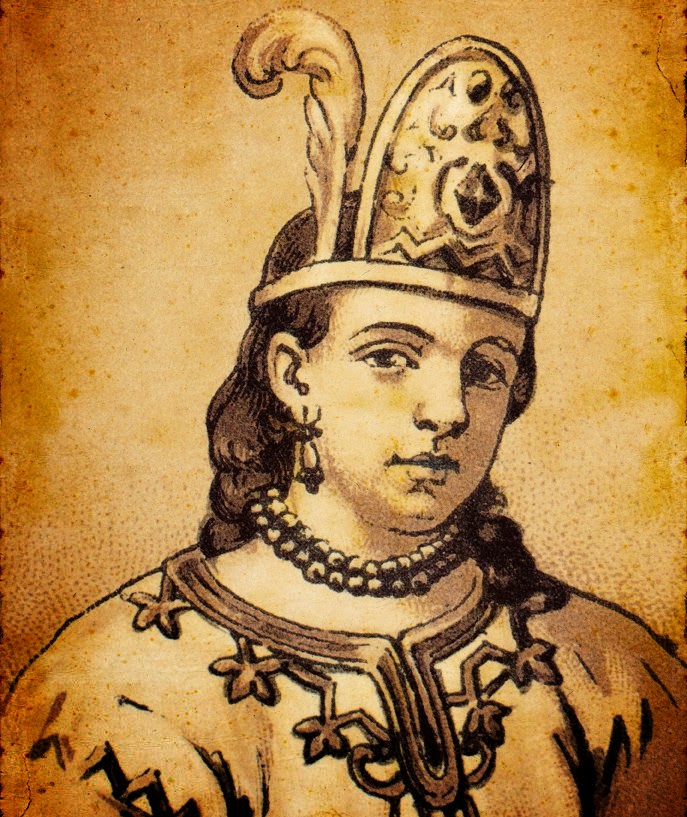
Not long after her introduction to Cortes, it was clear that La Malinche’s role would grow immensely. In the words of Bernal Diaz, a prominent conquistador during the conquest, La Malinche “had by her birth an universal influence and consequence through these countries; she was of a fine figure, frank manners, prompt genius and intrepid spirit; and an excellent linguist, and of most essential service to Cortes whom she always accompanied.” After learning Spanish, Cortes relied exclusively on La Malinche, as she evolved from a mere interpreter to a strategic partner, advising him in the most crucial moments of diplomacy and combat of the exploration.
Cortes first reported on the tactical advantage of La Malinche in the city of Cholula, a stop the conquistadors made on their journey to meet Montezuma. While staying in Cholula, La Malinche befriended the wife of a local nobleman. The wife warned La Malinche that Montezuma was sending a large conscription of Aztec warriors to the outskirts of the city, where they were planning to join Cholula forces on a surprise ambush of the conquistadors. Under the wife’s assistance, La Malinche was to separate from the Spanish ranks and marry a Cholulan captain, thereby escaping the impending doom that was to fall on the Spaniards. Instead of following the wife’s lead, La Malinche reported the plans to Cortes, who responded by unleashing a horrific attack on all Cholula nobles, warriors, women, and children. Historian Buddy Levy describes the premediated attack, “They fell upon the mostly unarmed populace in wholesale slaughter. Arrows whirred in horrific volleys, scything down scores in minutes as musket balls plowed others. Women and children ran screaming, many trampled by horses or by their own fleeting people.” The assault continued for days as conquistadors and their native allies “pillaged and burned houses, looted and slaughtered everyone they could find.” By the end of the days long slaughter, nearly five thousand Cholulan citizens lay dead on the streets. This horrific attack would send a shockwave all the way to Tenochtitlan, where Montezuma was receiving regular intelligence reports of the impenetrable march of the Spanish.
On that fateful day of November 8, 1519, Montezuma, decorated in an embroidered cloak, gold sandals, and green feathers, walked out to the entrance of his city on the Coyocan causeway to finally greet the men he had been tracking for several months. So much was strange and foreign to Montezuma witnessing the Spanish for the first time: the red and blonde beards, the “large deer” they were riding on (the horses the Spanish brought with them had been extinct in the Americas for thousands of years at this point), the ironclad armor they wore from head to toe, and most incredulously, the site of a native woman, La Malinche, by their leaders’ side ready to facilitate a diplomatic meeting. The exact contents of that meeting, you could say the translation of the conversation, is both hotly disputed to this day and absolutely vital to understanding the sequence of events that led to the fall of the Aztecs. Cortes claims in his letters to Spanish King Charles V that Montezuma surrendered to the Spanish Crown and accepted Charles V as his ruler in that initial meeting. However, the thought of the supreme leader ruling over the most powerful army in his known world acquiescing vassalage to a supposed King an ocean away is suspect, to say the least. Instead, its important to consider the customs and circumstances of that moment. The Aztecs, for all their brutality on the battlefield, valued hospitality to their visitors. Also, as a slave from a far off territory of the Aztec Empire, La Malinche had a very different dialect of Nahuatl then the royal class in the capital city. So, when Montezuma expressed common courtesies to his guest, like “I am at your service” or “the city is yours” the exact translation doesn’t match the sentiment. What’s likely the case is, upon hearing these rough translations from La Malinche, Cortes, either in a willful ignorance or naivety, used them as justification to dethrone Montezuma and declare the Spanish as the rightful rulers of his people.
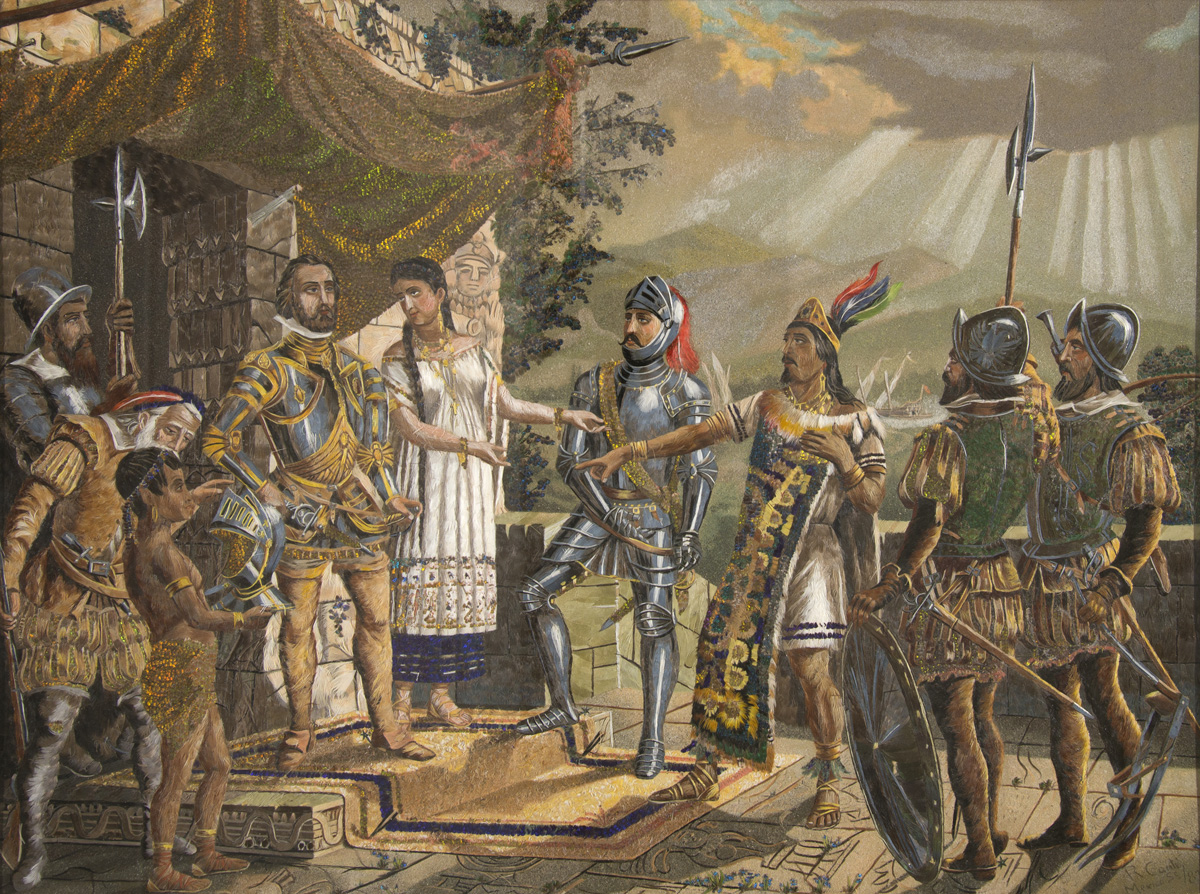
Cortes used this justification to wage full-scale war on the Aztecs. By August 1521, Montezuma was dead, his beloved Tenochtitlan was in ruins, and the Spanish replaced the Aztecs as the dominant power in Mexico.
Through La Malinche, the Spanish defeated the Aztecs by taking advantage of a lack of national unity in Mesoamerica and securing a coalition of native tribes…
The notion of just a few hundred Spanish conquistadors defeating an army of hundreds of thousands of Aztec warriors is apocryphal. In reality, the Spanish had amassed an allied army consisting of dozens of rival Mesoamerican tribes and Aztec tributaries that exceeded the Aztec army. But it wasn’t just brute force that led to Spanish success, it was also diplomacy with the natives – forging alliances, sharing resources, and forming power sharing agreements. It is through this lens that La Malinche’s true value is realized. The Spanish were true foreigners in Mexico, completely ignorant to local customs, culture, languages, and politics of the region. La Malinche didn’t just translate words and sentiments to the Spanish, she unveiled sources of discontent, dysfunction, and division within the Aztec Empire. This context became a weapon that Cortes and the conquistadors would wield against the entire Empire.
That discontent first materialized for Cortes in the coastal city of Cempoala. There, the Totonac people had very recently been defeated by the Aztecs and were forced to pay tributes to Montezuma as well as send their people to the Aztec capital for ritual human sacrifice. Learning of the conquistadors unlikely victory against much larger Mayan forces closer to the coast, they greeted the Spanish in celebration and flare. Totonac chief Tlacochcalcatl (also known as “the fat chief”) plotted with Cortes, through the services of La Malinche, providing him with fifty experienced warriors and a few hundred men to help guide the conquistadors as they made their way inland to Tenochtitlan. Before departing for the capital city, the fat chief relayed intel that would ultimately lead to the demise of the Aztec Empire: a large and fierce tribe in Tlaxcala was in open revolt against the Aztecs, and an alliance with the Tlaxcalans would neutralize the Aztec army.
With that knowledge in hand, Cortes made Tlaxcala his next stop. The Tlaxcalans initially greeted the Spanish with hostility, but after days of fighting, Tlaxcalan forces suffered countless deaths as the Spanish rode day and night to villages and hamlets, burning everything in sight and killing everyone they encountered. In the words of Cortes following a night raid in one of the villages, “I took them by surprise, they rushed out unarmed, the women and children running naked through the streets, and I began to do them some harm.” In response to sustained attacks and atrocities, Tlaxcalan nobles sent emissaries to negotiate a peace and an alliance against the Aztecs. For a critical twenty days, Cortes and his men stayed in Tlaxcala to exchange gifts, pleasantries, and plans for their march into Tenochtitlan.
Cortes is conventionally credited with spearheading these alliances, but that interpretation ignores the intermediary role La Malinche served in facilitating communications between the Spanish and the Tlaxcalans. Bernal Diaz praised her “virile strength” in his memoir, Cortes reported her linguistic skills to King Charles V, and even the Liezno de Tlaxcala, a comprehensive manuscript of Tlaxcalan history written in the sixteenth century, depicts La Malinche’s central role alongside Cortes during these crucial meetings. This universal recognition of La Malinche is particularly remarkable given the subordinate role women played in both Spanish and Mesoamerican societies at the time. In most cases, she is the only women described and depicted in the interactions that secured an alliance responsible for the demise of the Aztec Empire. Tlaxcala, like Tenochtitlan, was the dominant power of a triple alliance that stretched back decades with Huexotzinco and Cholula and likely saw the Spanish as their vehicle to reclaim and replace their regional power from Tenochtitlan. As the only rival tribe that could come close to matching the military strength of Montezuma’s Aztec warriors, the Tlaxcalans would represent Cortes’ primary fighting force, offering up to one hundred thousand warriors throughout the Spanish-Aztec War. In later years, Bernal Diaz would astutely observe that without the Tlaxcalans, “no Spaniard would have escaped the Mexica.”
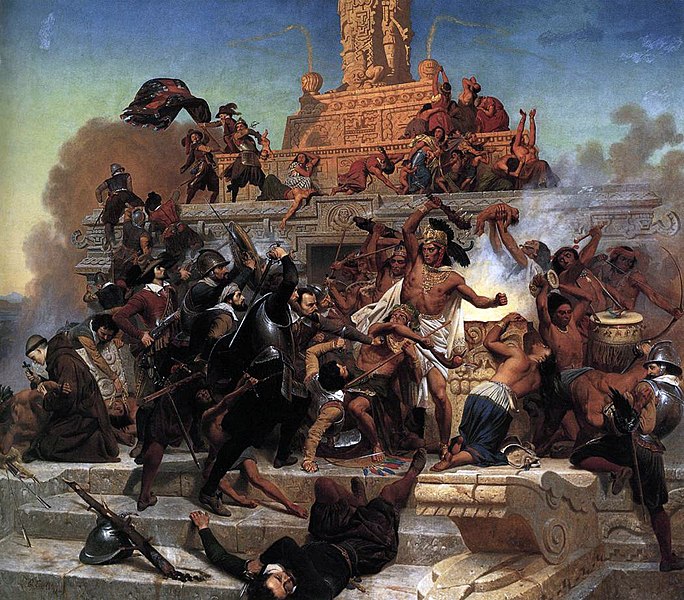
It wasn’t just the Tlaxcalan alliance that aided the conquistadors, it was a region-wide reluctance to band together, to unite under one native people and defeat a common enemy in the Spanish. As the conquest dragged on, Aztec emperors and emissaries reached far and wide to recruit local tribes in defense of Tenochtitlan, but in almost every case, those tribes declined, weary of the reputation of the Aztecs to deceive and oppress. Though they were united by common religions, languages, and ancestry, the hundreds of diverse Mesoamerican civilizations only saw themselves as Mexica (Aztecs), Tlaxcalans, Totonacs, Tarascans, Chalcans, Cholulans, Otomi, etc., instead of a united people. That lack of national identity contributed most to the fall of the Aztec Empire and ultimately to the broader displacement of indigenous tradition for Spanish-Christian ideology in Central America.
The meeting of Montezuma and Cortes set in motion a global political and economic order that has shaped the construct of our modern world…
For three months in 1521, the Aztecs withstood a relentless siege from about one thousand conquistadors and hundreds of thousands of their allied native warriors. With the loss of their leader, Montezuma, their fresh water sources cutoff by the Spanish, their food supply diminished by a massive disruption in their harvest schedule, and their health deteriorating from a smallpox epidemic, the Aztecs finally surrendered to Cortes on August 13, 1521. In a matter of two years, the Spanish had scorched through the heart of the Mexican mainland, defeated the largest empire in Mesoamerican history, and opened the door for a period of conquest and colonization that would forever change the course of human history.
Tenochtitlan, once a majestic city of culture and splendor, was left to a pitiful ruin. For days, the city’s residents, in a general malaise, limped their way out of the city, harassed by greedy gold seeking conquistadors as they struggled for survival in an uncertain future. Life in modern-day Mexico would never be the same.
The epidemic of smallpox and the onslaught of other European born diseases wiped out large swaths of the native population in the 1500’s, with estimates citing about a 90% population decline from pre-Cortes to 1600. The native culture was largely displaced – Nahuatl with Spanish and Latin; idols, temples, and ancient sculptures with crosses, churches, and the Virgin Mary. Indigenous festivals, traditions, books, even diets were outlawed, accused of being works of the devil. Tens of thousands of native women and children were, through the course of the war and the years after as the Spanish settled Mexico, condemned to a lifetime of slavery. Backed by accounts and inventories of conquistadors, as well as edicts and inquiries from the Spanish Crown, conquistadors imposed a mass scale of slavery and sexual exploitation all across Central America, tearing families and entire communities apart. Cortes alone owned 287 slaves, predominantly children and teenagers, according to an inventory of his estate in Cuauahnahuac. Slavery and servitude of native peoples was at times backed by Spanish law, as in the case of the Encomienda system, or legitimized by loopholes in Crown policy. This systemic subjugation of native populations served as a model for empire building for centuries to come as the European powers would jostle for control of the New World until the twentieth century.
Cortes won the ultimate prize when on September 13, 1523, the Spanish Crown named him Captain-General and Governor of the Mexican mainland, then called New Spain. However, his fortunes would run out towards the latter half of his life. Before his death in 1547, Cortes would face a litany of lawsuits, personal attacks, and challenges to his authority. Falling out of favor with the Spanish Crown, his title of Governor of New Spain was revoked in 1528. He was in turn commissioned to settle the Pacific coast in hopes of finding a trade route directly to Asia. Instead, what followed was a series of fruitless and self-destructive expeditions in the mostly barren islands of the Pacific. Cortes would return to Spain for the last decade of his life bitter and indignant, having been exposed within his circle of influencers for the meager man he truly was.
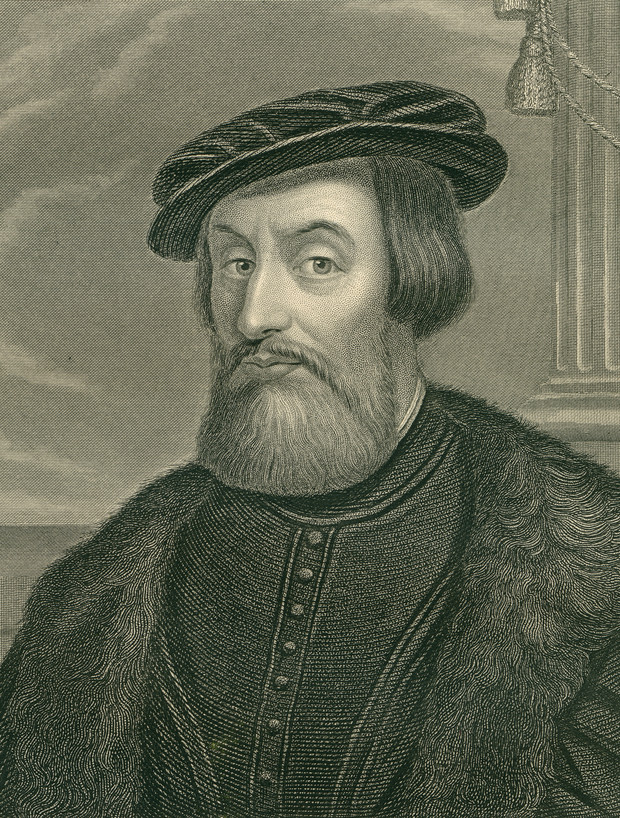
However, the heroic legend of Cortes, the myths of courage and triumph, would spread for hundreds of years after the conquest. Inspired by Cortes, Francisco Pizarro would conquer the Incan Empire in Peru, bringing territory from Ecuador to Chile under Spanish control. In just half a century, Spain would grow from a factitious collection of territories embroiled in sectarian conflicts to the eminent world power.
The promise of wealth, vast land, and worldwide influence would entice European powers to mimic the Spanish model, venturing out to the far corners of the world, whether it was the English in North America and India, the French in Africa and Canada, or the Dutch along the Eastern Coast of America. What resulted was the age of globalization and the construct of our modern world. Through the Columbian Exchange, the Spanish introduced a cross continent system of trade that brought Mesoamerican goods and crops to Europe in exchange for European livestock and culture. In fact, many of the modern “authenticities” we attribute in today’s world can be linked to that meeting between Cortes, Montezuma, and La Malinche. Pizza in Italy, potatoes in Ireland, hot chilies in India, steak in Argentina, and beautiful baroque churches in Mexico City are all byproducts of a globalized network of trade starting in the 16th century that brought tomatoes, potatoes, and chili peppers to Europe and Asia, and introduced cattle, Christianity, and horses to the Americas.
The legacy of La Malinche is much more muddled. After the Aztec surrender, she bore a son to Cortes, in what was most likely a non-consensual relationship. She would later be married to one of Cortes’ captains, Juan Jaramillo, before passing away shortly thereafter from an apparent smallpox outbreak in Mexico. Without a single personal account of her own, we don’t have the proper context for her experiences and her state of mind during the Spanish conquest. Instead, we are left with secondary interpretations from the native peoples that enslaved her and the Spanish that exploited her.
Since then, she has generally been denigrated by historians, writers, and public officials. The nationalist agenda of Mexico for much of the 19th century regarded La Malinche as a promiscuous and submissive traitor that caused the displacement of their native culture. That interpretation ignorantly leaves out the fact that she was a slave held against her will with the Spanish and for about ten years prior to meeting Cortes. It also ignores the universal reverence she received in early Spanish and Mesoamerican accounts of the Spanish conquest. Indeed, La Malinche’s presence is one of the only constants across 15th and 16th century accounts, where she is referred to as “Malintzin” to the natives (the suffix “tzin” denotes respect in Nahual) and “Dona Marina” to the Spaniards (“Dona” being a symbol of honor in Spanish).
It is only until recently, with the spread of the Feminist Movement taking hold in the 1960’s, that La Malinche has been appreciated for the fascinating historical figure that she is. Born into Aztec nobility, sold into slavery, then married into Spanish aristocracy, La Malinche is one of those historical anomalies that leaves you longing, wondering “what more we would know, if only we knew you more.”
Resources
Thomas, Hugh. Conquest: Montezuma, Cortes, and the Fall of Old Mexico. Simon & Schuster, 1993.
Levy, Buddy. Conquistador: Hernan Cortes, King Montezuma, and the Last Stand of the Aztecs. Bantam Books, 2008.
Restall, Matthew. When Montezuma Met Cortes: The True Story of the Meeting That Changed History . HarperCollins, 2018.
Cypess, Sandra Messinger. La Malinche in Mexican Literature: From History to Myth. University of Texas Press, 1991.
Harari, Yuval Noah. Sapiens: A Brief History of Humankind. HarperCollins, 2015.
Aguilera, Elizabeth. “Malintzin as a Visual Metaphor in the Lienzo De Tlaxcala.” University of California, Santa Barbara , 2014, pp. 8–24.
 The Catalyst